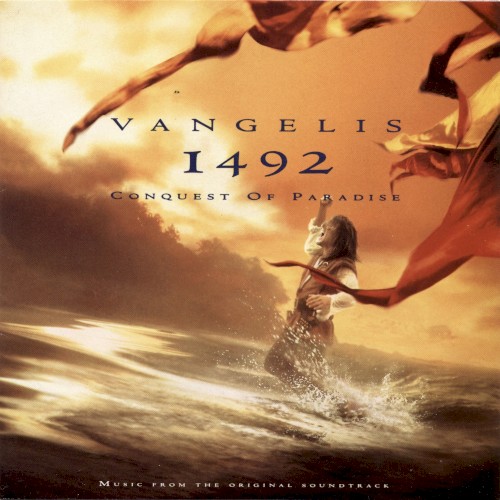
Album Information Section
Album Title: 1492: Conquest of Paradise: Music From the Original Soundtrack
Artist: Vangelis
Original Release Date: October 12, 1992
Label: Unknown Label
Genres: Soundtrack, Electronic
Track Listing:
- 1. Opening (1:21)
- 2. Conquest of Paradise (4:48)
- 3. Monastery of La Rabida (3:39)
- 4. City of Isabel (2:16)
- 5. Light and Shadow (3:47)
- 6. Deliverance (3:29)
- 7. West Across the Ocean Sea (2:53)
- 8. Eternity (2:00)
- 9. Hispanola (4:57)
- 10. Moxica and the Horse (7:06)
- 11. Twenty Eighth Parallel (5:14)
- 12. Pinta, Nina, Santa Maria (Into Eternity) (13:20)
Recording Information
The album “1492: Conquest of Paradise” was recorded at Vangelis’ own studio, Nemo Studios, located in London, England. The recording sessions took place in the early 1990s, primarily between 1991 and 1992, as Vangelis worked on the score for the film directed by Ridley Scott. Vangelis himself served as the producer and engineer for this project, utilizing a variety of synthesizers and orchestral elements to create the rich, atmospheric sound that characterizes the album.
Notably, Vangelis employed innovative recording techniques, blending traditional orchestration with electronic music to evoke the grandeur of exploration and discovery. His use of the Yamaha CS-80 synthesizer, along with samples and layered sounds, allowed him to craft a cinematic soundscape that resonated with the themes of the film. An interesting production note is that the iconic main theme, “Conquest of Paradise,” became a hallmark of Vangelis’ career, achieving widespread recognition and usage in various media beyond the film itself.
Band Context
At the time of the album’s release, Vangelis was already an established composer known for his pioneering work in electronic music. Having gained fame for soundtracks such as “Chariots of Fire” (1981) and “Blade Runner” (1982), Vangelis was at the height of his creative powers. His innovative approach to sound and music composition made him a sought-after artist in the film industry. Leading up to “1492,” Vangelis had been experimenting with integrating orchestral music and electronic sounds, a theme that continued to flourish in this album.
During this period, Vangelis worked mostly as a solo artist, and he was known for his reluctance to perform live, which allowed him to focus entirely on his studio work. This commitment to his craft resulted in a unique sound that combined lush melodies with intricate arrangements. The success of “1492: Conquest of Paradise” further solidified Vangelis’ status as a master composer, capable of creating music that transcended the film industry and entered popular culture.
Track Commentary
The album opens with “Opening,” a brief but captivating introduction that sets the tone for the cinematic experience to follow. The titular track, “Conquest of Paradise,” is undoubtedly the standout piece, featuring a majestic melody that has become synonymous with Vangelis’ work. The use of choir and orchestration in this track elevates its emotional impact, making it a favorite for various events and presentations.
Tracks such as “Monastery of La Rabida” and “City of Isabel” showcase Vangelis’ ability to create vivid soundscapes that transport listeners to historical moments. “Moxica and the Horse” is another notable composition, with its longer runtime allowing for an intricate exploration of themes related to conquest and the clash of cultures. The album concludes with “Pinta, Nina, Santa Maria (Into Eternity),” a sweeping piece that encapsulates the journey of discovery and exploration.
Critical reception of the album was generally positive, with many praising Vangelis’ ability to blend orchestral and electronic music seamlessly. Over the years, the track “Conquest of Paradise” has been particularly influential, often used in various media and public events, cementing its legacy as one of Vangelis’ most recognizable compositions. The album as a whole remains a testament to Vangelis’ artistic vision and his ability to evoke powerful emotions through his music.
