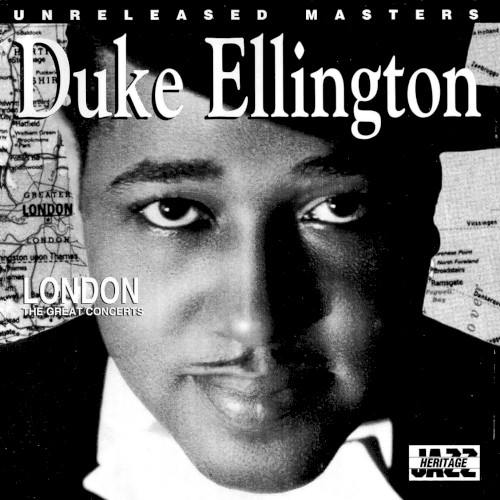
Album Information Section
Album Title: The Great London Concerts
Artist: Duke Ellington & His Orchestra
Original Release Date: 1994
Label: Jazz Heritage
Genres: Jazz, Big Band
Track Listing:
- 1. Take the “A” Train (instrumental introduction) (0:57)
- 2. Duke Ellington: Introduction (0:22)
- 3. Perdido (4:02)
- 4. Caravan (5:21)
- 5. Isfahan (4:30)
- 6. The Opener (3:11)
- 7. Harlem (15:01)
- 8. Take the “A” Train (vocal) (3:25)
- 9. Mood Indigo (2:47)
- 10. “C” Jam Blues (3:24)
- 11. Don’t Get Around Much Anymore (3:09)
- 12. Diminuendo and Crescendo in Blue (11:22)
- 13. Single Petal of a Rose (4:06)
- 14. Kinda Dukish & Rockin’ in Rhythm (5:06)
Recording Information
The Great London Concerts was recorded at the famed Royal Festival Hall in London, England. The concerts that comprise this album were recorded during a series of performances in the year 1963, marking an important period in Ellington’s career as he continued to solidify his legacy as one of the most influential figures in jazz history.
The album was produced by George Avakian, a well-respected figure in the jazz world known for his work with several major artists. The engineering was handled by John McClure, who utilized advanced recording techniques for the time, ensuring that the vibrant sound of the orchestra was captured accurately. Notably, the use of multi-track recording allowed for a separation of instruments, giving listeners a clearer auditory experience of Ellington’s complex arrangements.
One interesting production note is that the recording captured the live energy of the performances, which was a hallmark of Ellington’s concerts. This album serves as a document of the band’s ability to engage with an audience, blending improvisation with tightly arranged compositions.
Band Context
During the early 1960s, Duke Ellington & His Orchestra was at a pivotal moment. Ellington, who had been leading his band since the late 1920s, was experiencing a renaissance in popularity, fueled by a renewed interest in jazz and the cultural movements of the time. The orchestra had undergone several changes in personnel over the decades, but by this period, it included many talented musicians who were well-versed in both traditional jazz and the evolving styles of the era.
The lineup during the recording of The Great London Concerts featured key members such as Johnny Hodges on alto saxophone, Paul Gonsalves on tenor saxophone, and Cootie Williams on trumpet, among others. This ensemble was known for its rich sound and ability to navigate complex arrangements with ease.
Before this album, Ellington had been touring internationally, gaining acclaim in Europe and beyond. The concerts that resulted in this recording were a part of a broader effort to showcase jazz as an art form on the global stage, highlighting the band’s ability to connect with diverse audiences.
Track Commentary
The Great London Concerts features a well-curated selection of some of Duke Ellington’s most famous compositions. The album opens with the instrumental introduction of Take the “A” Train, a tune that serves as a signature piece for the orchestra, setting the stage for the high-caliber performances to follow. The subsequent tracks, such as Caravan and Perdido, showcase the band’s ability to blend intricate melodies with the improvisational flair characteristic of jazz.
One of the standout tracks is Harlem, which spans an impressive 15 minutes. This piece encapsulates the vibrant energy and intricate rhythms of urban life in Harlem, highlighting Ellington’s deep connection to the cultural landscape of the time. The live performance format allows for extended solos, particularly from Hodges and Gonsalves, adding to the track’s emotional depth and complexity.
Another notable piece is Diminuendo and Crescendo in Blue, a composition that features a famous solo by Paul Gonsalves, which became legendary in its own right. The track illustrates Ellington’s unique ability to blend structured composition with free-form expression.
Overall, The Great London Concerts not only serves as a celebration of Duke Ellington’s artistry but also stands as a significant historical document, capturing the essence of a band that was at the forefront of jazz innovation. The album has been well-received by critics and fans alike, often regarded as an essential listening experience for anyone interested in the evolution of jazz music.
