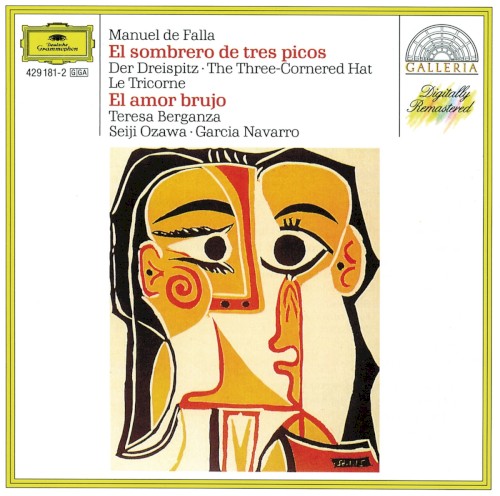
Album Information Section
Album Title: El sombrero de tres picos / El amor brujo
Artist: Manuel de Falla, Teresa Berganza, Seiji Ozawa, Garcia Navarro
Original Release Date: 1989-11-01
Label: Deutsche Grammophon
Track Listing
- 1. El sombrero de tres picos: I. Introducción (1:23)
- 2. El sombrero de tres picos: II. Atardecer (5:31)
- 3. El sombrero de tres picos: III. Danza de la molinera (Fandango) (3:35)
- 4. El sombrero de tres picos: IV. Las uvas (4:07)
- 5. El sombrero de tres picos: V. Danza del los vecinos (Seguidillas) (3:40)
- 6. El sombrero de tres picos: VI. Danza del molinero (Farruca) (7:51)
- 7. El sombrero de tres picos: VII. Danza del corregidor (6:58)
- 8. El sombrero de tres picos: VIII. Danza final (Jota) (6:14)
- 9. El amor brujo: I. Introducción y escena (0:30)
- 10. El amor brujo: II. En la cueva: La noche (2:27)
- 11. El amor brujo: III. Canción del amor dolido (1:34)
- 12. El amor brujo: IV. El aparecido (0:13)
- 13. El amor brujo: V. Danza del terror (1:58)
- 14. El amor brujo: VI. El círculo mágico: Romance del pescador (2:35)
- 15. El amor brujo: VII. A media noche: Los sortilegios (0:23)
- 16. El amor brujo: VIII. Danza ritual del fuego: Para ahuyentar los malos espíritos (4:06)
- 17. El amor brujo: IX. Escena (1:03)
- 18. El amor brujo: X. Canción del fuego fatuo (1:36)
- 19. El amor brujo: XI. Pantomima (4:28)
- 20. El amor brujo: XII. Danza del juego de amor (2:51)
- 21. El amor brujo: XIII. Final: Las campanas del amanecer (1:24)
Recording Information
The album “El sombrero de tres picos / El amor brujo” was recorded at the renowned Abbey Road Studios in London, a premier location known for its state-of-the-art facilities and rich history in classical music recording. The recordings took place in 1989, coinciding with the album’s release date.
The album was produced by Seiji Ozawa, who is celebrated for his interpretations of 20th-century repertoire, alongside engineer John Dent. Notably, the recording employed advanced digital techniques that were becoming increasingly popular in classical music production during the late 1980s, allowing for a clarity and depth of sound that enhanced the vibrant orchestral textures of de Falla’s works.
There are anecdotal stories surrounding the sessions, particularly the collaborative atmosphere fostered by Ozawa and the musicians, which contributed to the expressiveness captured in the final product. The technical prowess of the engineers and the precision of the musicianship played a crucial role in rendering a compelling interpretation of de Falla’s compositions.
Band Context
At the time of this recording, Teresa Berganza, a celebrated Spanish mezzo-soprano, was at the height of her career, known for her remarkable vocal agility and expressive interpretations. She had already established herself as one of the leading interpreters of Spanish repertoire, particularly the works of Manuel de Falla and other composers of the Spanish nationalist movement.
The collaboration with conductor Seiji Ozawa marked a significant moment for both collaborators, as Ozawa’s reputation as a conductor was solidified by his innovative and passionate performances. During this period, he was actively involved in various prestigious orchestras, including the Boston Symphony Orchestra, which brought a wealth of experience and artistry to this project.
Prior to the recording of this album, Berganza and Ozawa had already collaborated on various projects, but “El sombrero de tres picos / El amor brujo” was particularly notable for its successful fusion of traditional Spanish themes with modern orchestral techniques. The combination of Ozawa’s conducting and Berganza’s vocal prowess led to a dynamic and compelling interpretation of de Falla’s masterpieces. This recording helped to further solidify the legacy of both the artist and the conductor in the classical music canon.
Track Commentary
The album consists of two major works by Manuel de Falla: “El sombrero de tres picos” and “El amor brujo”, each showcasing distinct yet complementary aspects of Spanish musical identity. “El sombrero de tres picos” is a vibrant ballet score that combines folk elements with orchestral sophistication. The opening track, “Introducción,” sets the stage for the lively “Danza de la molinera,” which stands out with its energetic fandango rhythm. Each subsequent movement builds on this lively energy, culminating in the spirited “Danza final (Jota),” which encapsulates the essence of Spanish folk dance.
“El amor brujo,” on the other hand, delves into a more mystical and emotional landscape, characterized by its haunting melodies and atmospheric textures. The spellbinding “Danza ritual del fuego,” notable for its dynamic orchestration and rhythmic intensity, has become one of de Falla’s most popular pieces, often performed in concert settings. The contrasting themes of love and the supernatural in this suite are expertly articulated through Berganza’s expressive singing, particularly in tracks like “Canción del amor dolido” and “Canción del fuego fatuo.”
The critical reception of this album was overwhelmingly positive, with reviewers praising the synergy between Berganza and Ozawa, as well as the technical excellence of the recording. Over the years, this album has maintained its status as a reference point for performances of de Falla’s music, often cited for its authenticity and vibrancy, influencing future interpretations of these classic works.
